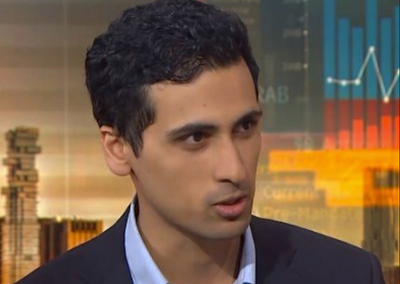

Gbenga Ajilore
Chief Economist, Center on Budget and Policy Priorities
Washington, DC
Experience
- Senior Advisor, U.S. Department of Agriculture Office of the Undersecretary for Rural Development
- Senior Economist, Center for American Progress
- Associate Professor of Economics, University of Toledo
Expertise
- U.S. economic policy
- Rural issues
Education
- Claremont Graduate University, Ph.D. (Economics)
- University of California, Berkeley, B.A. (Applied Mathematics and Economics)
Recent Coverage
APRIL 3, 2026
Iowa Public Radio | What’s shaping Iowa’s farm economy this spring?
We begin with Benton County farmer Lance Lillibridge, who argues consolidation in the fertilizer industry is the root cause of spiking prices amid the war against Iran. Then, former USDA official Gbenga Ajilore weighs in on the war’s impact to farmers, following President Donald Trump’s television address Thursday night.
FEBRUARY 13, 2026
Politico Morning Money | How deficit politics looms over the family farm
Gbenga Ajilore, chief economist at the Center on Budget and Policy Priorities and a former USDA staffer, said it might be too complicated for Congress to make cuts to core agricultural support programs like crop insurance, but ad hoc bailouts could face a more uncertain future. Without cash infusions — and with the persistence of tariffs — some farms could run the risk of bankruptcy. But it’s unclear what that might mean for commodity prices, he said. Those bankrupted entities could be “bought out by larger operations, and then you have more acreage. That actually might get you lower prices,” he said. On the other hand, more consolidation could also give the remaining firms more room to raise prices. “It just depends on the actual market itself because each [commodity] market is different,” he continued.
FEBRUARY 5, 2026
Marketplace | Why are unemployment rates climbing for black workers?
One development in particular has driven the increase in unemployment among Black workers, said Gbenga Ajilore, chief economist at the Center on Budget and Policy Priorities: sharp cuts to federal employment. “This time last year we had the Department of Government Efficiency or DOGE basically taking a chainsaw to the federal workforce, historically the place Black households have been able to find good jobs, well-paying jobs, with pension benefits,” he said. “The federal workforce lost almost 270,000 jobs last year, and that’s going to be disproportionately Black workers,” Ajilore said. One more factor pushing Black unemployment higher, Ajilore said, is a slump in manufacturing. “Manufacturing employs a lot of Black households,” he said. “And tariffs had a huge impact on manufacturing, losing about 70,000 jobs since April of 2025, the time of Liberation Day.”